




AUDIENCE REVIEW: A Thousand Leaves: Finding Beauty in Order
Company:
Lulu ZHU
Performance Date:
3 November 2026
Freeform Review:
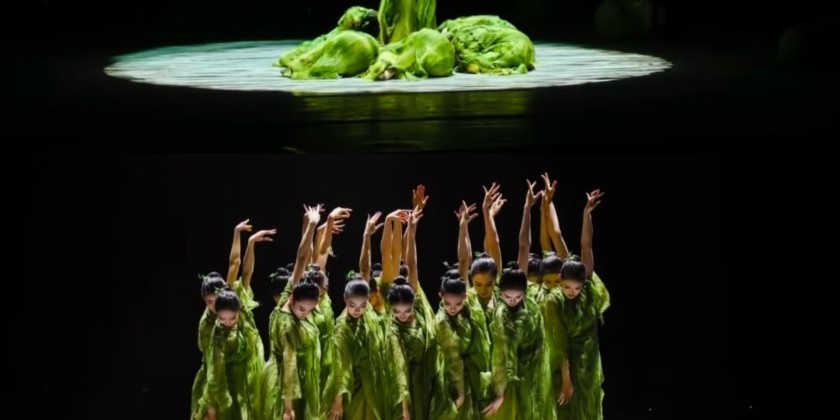
There is something rather lovely about the sight of a stage full of dancers in green. In A Thousand Leaves, choreographed by Lulu Zhu and presented at Joinus Future Arts Centre Theatre, the dancers are gathered within a circular pool of light. The green fabric catches the light beautifully, giving the impression of foliage emerging from the darkness. It is a simple theatrical image, but a memorable one.
A Thousand Leaves has a rather different aesthetic from much of the contemporary dance being made today. In recent decades, choreographers have increasingly questioned conventional notions of beauty, exploring pedestrian movement, physical awkwardness, vulnerability and the less comfortable aspects of human experience. Beauty has sometimes become almost incidental to the wider concerns of a work. Here, however, it is central to the artistic intention.
There is nothing particularly radical about making beautiful dance, of course, but it is worth considering what beauty means within contemporary choreography. The elegance of classical dance is often associated with an established movement vocabulary, whereas contemporary dance offers considerably more freedom in the way the body can be used. A Thousand Leaves occupies an interesting position somewhere between these two approaches.
The influence of Chinese dance is unmistakable. It can be found in the attention to line, the delicacy of gesture and, perhaps most importantly, the arrangement of bodies within the theatrical space. The composition has much in common with Chinese painting, where the relationship between individual elements is often as important as the subjects themselves. A figure may have little significance in isolation, yet its presence can completely alter the balance of the picture.
This is particularly apparent in the ensemble work. The dancers gather into dense formations, with relatively small differences in height and direction creating considerable visual variety. The group is treated almost as a single choreographic entity. Individual bodies contribute to a larger image, and the complexity of the composition comes from their relationship to one another.
It is a sophisticated approach to group choreography. There is always a danger when working with a large ensemble that the sheer number of dancers becomes the principal attraction. Here, the numbers serve a compositional purpose. The density of the group, its uneven outline and the distribution of bodies across different levels give the work a distinctive visual character.
The theatrical design is particularly sympathetic to this approach. The green costumes soften the boundaries between individual dancers, while the surrounding darkness allows the groupings to be seen with remarkable clarity. There is little need for elaborate scenery. The dancing bodies provide much of the visual substance of the work.
Yet the emphasis on visual composition also raises some interesting questions about the choreography itself. The stage pictures are carefully constructed, sometimes so carefully that the physical experience of the dancers seems secondary to the appearance of the ensemble. There is a certain uniformity in the way the movement is presented. Even where the formations are asymmetrical, the individual performances remain remarkably orderly.
Unison has always been a valuable choreographic device. Its effectiveness, however, often depends on what surrounds it. A sudden moment of collective movement can be extraordinarily powerful when it emerges from a more individually driven physical language. When precision becomes the prevailing condition of a work, some of that dramatic power is lost.
There is perhaps too little room for physical spontaneity in A Thousand Leaves. The dancers have a shared movement vocabulary, but there seems to be limited scope for them to explore its possibilities as individuals. Greater variation in dynamics, phrasing and the use of weight might bring another dimension to the ensemble work. The occasional break from the collective rhythm could also give the more tightly organised passages greater significance.
Contemporary dance has opened up an understanding of the body in which individuality is an important part of the performance. A movement may be shared by several dancers without being experienced or expressed in quite the same way by each of them. Those differences can bring considerable richness to a piece of choreography. In A Thousand Leaves, the pursuit of visual harmony leaves relatively little space for such differences to emerge.
There is a certain irony in this, given the work's association with nature. A landscape may appear harmonious when viewed from a distance, but closer inspection reveals all manner of irregularities. Nothing grows at quite the same rate or in quite the same direction. The beauty of the natural world owes a great deal to these imperfections. A less regulated approach to movement might bring the choreography closer to the very subject that gives the work its visual identity.
Nevertheless, the aesthetic behind A Thousand Leaves is worth taking seriously. Contemporary dance is a broad art form, and there is no particular reason why a choreographer should feel obliged to reject elegance, harmony or established cultural aesthetics in order to produce contemporary work. The Chinese artistic tradition offers a wealth of possibilities for choreography, many of which remain relatively unfamiliar within Western contemporary dance practice.
The particular interest of A Thousand Leaves lies in its exploration of those possibilities. Its visual identity is strong, and its treatment of the ensemble demonstrates a considerable understanding of theatrical composition. Where the work is less convincing is in its exploration of the expressive freedom that contemporary movement affords.
There is much to admire in the beauty of these carefully constructed images. How much more interesting they might become if the dancers were occasionally allowed to disturb them.
Author:
Cathy Brown