

Related Features
Center for Performance Research (CPR) Announces New Technical Development Residency
IMPRESSIONS: A Sunday in Spring 2026: Cathy Weis Projects’ Sundays on Broadway
IMPRESSIONS: Das Besties and Billy McEntee Present "Das Raushgift" at Box of Moonlight, Bushwick

By Kate Purdum
View Profile |
More From This Author
Published on December 31, 2025
Photo: Jose Miranda (@pelenguino)
Created by: Travis Amiel, Cosimo Pori, Nina Lucia Rodriguezm and Arzu Salman
Performed by: Travis Amiel, Cosimo Pori, Nina Lucia Rodriguezm and Arzu Salman
Scenic design: Joe Burt
Lighting design: Connor Sale
Costume design: Nina Lucia Rodriguez
Costume assistant: Hannah Bird
Illusion design: Reuven Glezer
Stage management: Emily Wong
Produced by: Das Besties and Billy McEntee
at Box of Moonlight in Bushwick
December 4 - 21, 2025
Das Rauschgift, the latest collaboration from Brooklyn-based dance-theatre duo Travis Amiel and Cosimo Pori (aka Das Besties) is a playful, exuberant, and ultimately tender tale about the trials and tribulations of having a good time.
The title — in German, as is custom for Das Besties — roughly translates to the sensation granted by a poison-adjacent substance with the power to alter consciousness. Accordingly, the piece explores partying, catharsis, and sublime regret.
Upon entering Box of Moonlight in Bushwick — Das Rauschgift’s bare, warehouse venue — patrons are greeted with a foggy, moody atmosphere, conjuring the murky haze of an under-bridge rave. The wide, shallow playing space, laid with marley flooring, is bare except for a plate of fresh chocolate chip cookies and a cup of milk, gleaming under a single spotlight.
The four performers — Travis Amiel, Cosimo Pori, Nina Lucia Rodriguez, and Arzu Salman — enter, and the disembodied voice of Kyle Richards, Real Housewife of Beverly Hills, proclaims “We were all so happy that day, it's actually hard to even imagine how terrible things would soon become.” We’re off to the races.
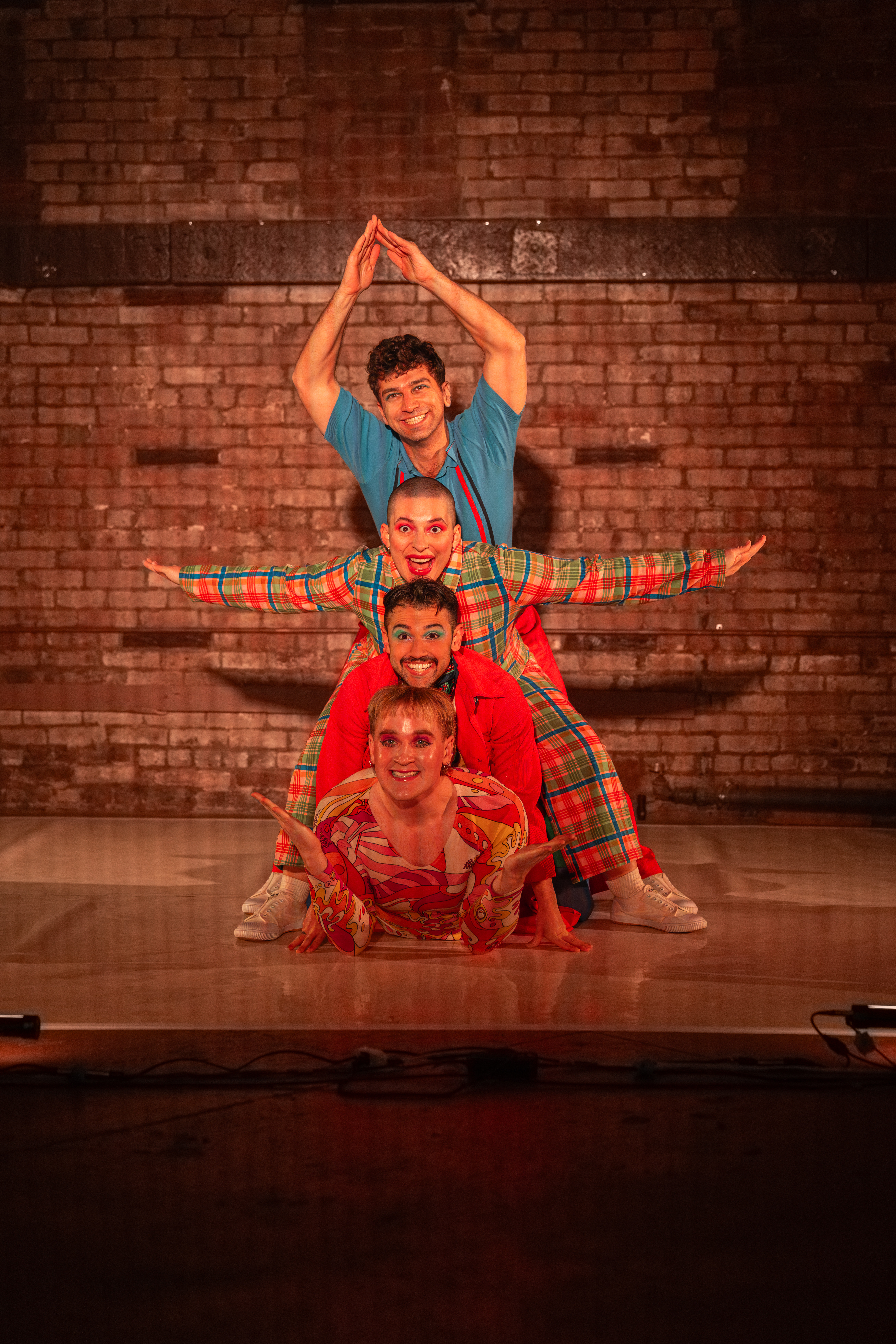
(Top to bottom) Travis Amiel, Nina Lucia Rodriguez, Arzu Salman, and Cosimo Pori. Photo: Jose Miranda (@pelenguino)
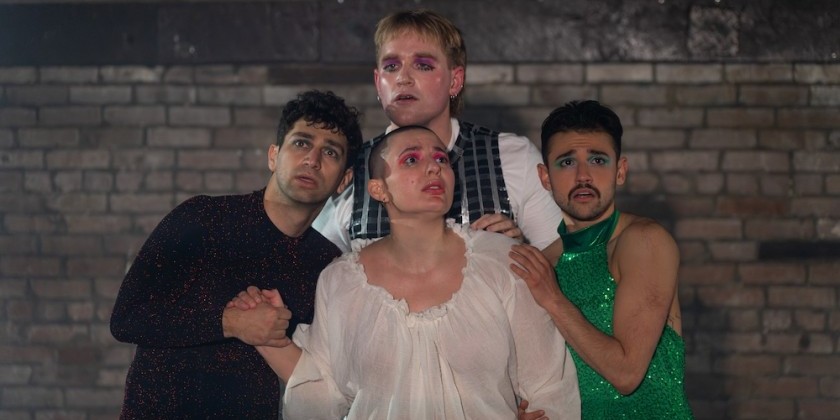
The performers, playing versions of themselves, are costumed (by Nina, with assistance from Hannah Bird) in 70s colors and silhouettes — a multi-color plaid jumpsuit, a swirly paisley top, culottes — in vibrant reds, yellows, and greens, and four identical pairs of white sneakers. They dance a joyful montage, skipping through proverbial fields, gleeful and in the thrall of friendship. The set, by Joe Burt, is spare and unobtrusive, occasionally populated by clever items and microphone stands. The besties enjoy a beach day, spray each other with seltzer, and a beautiful kite prop arrives, before a fog emerges and swallows Arzu out to sea with his kite while he furiously kicks and struggles.
Transitions between scenes are immediate, and we move from one episode to the next with a jolt of colored light (excellently designed by Connor Sale) or a meme-adjacent soundbyte. Suddenly, all four performers are downstage in a line, step-touching as they recite not-quite-accurate aphorisms like, “teach a fish to swim and you’ll never work a day in your life.” Cosimo, Arzu, and Nina sink to the floor and clutch each other, writhing in a circle, as Travis stands in the center.
“Cookie now, cookie later, cookie forever,” he chants over and over in a growing fervor. The audience can’t help but chant along. “What’s the point of life,” Travis asks, “if there’s no cookie?”
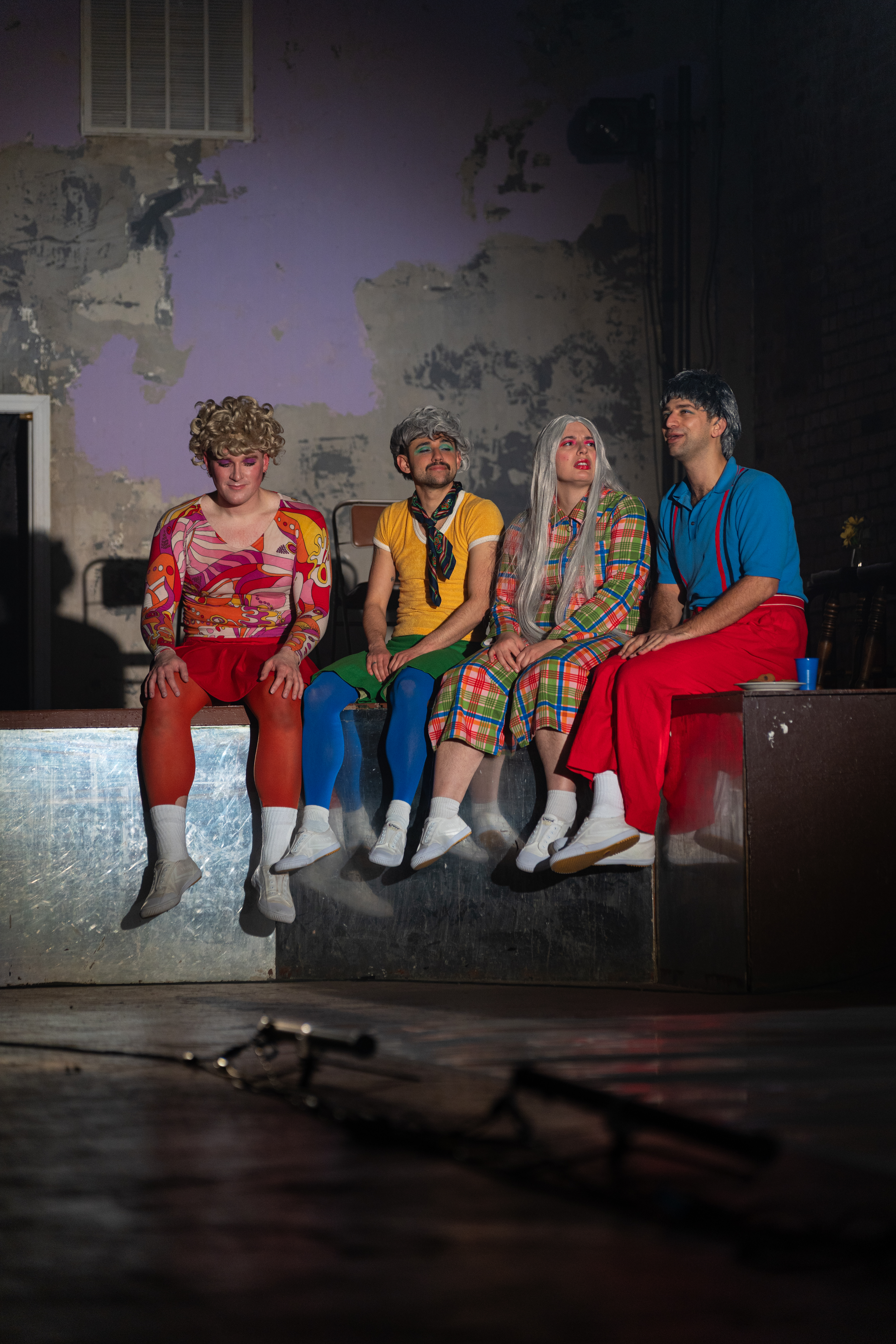
Cosimo Pori, Arzu Salman, Nina Lucia Rodriguez, and Travis Amiel. Photo: Jose Miranda (@pelenguino on Instagram)
The lights glow red and there’s another episode of presentational choreography, set this time to triumphant jazz, in a Jerome Robbins-esque series of leaps and street-scene duets. This evolves into a searching, yearning solo for Cosimo, where a series of slide projected psychedelic spirals becomes a close up image of a petri dish of swirling liquid. It looks like a bird’s eye view of Earth, or the inside of a cell. Cosimo is dwarfed by the sheer scale of it all.
Nina, continually apart and reluctant to imbibe, tries to break through as the besties make plans for another night out dancing. They beg her to tag along to a series of bizarrely-named fictional nightclubs, and the more she resists, the harder they push, chanting “Come play with us, Nina,” as she buckles under their threats. She screams an endless high-pitched scream, punctuated by the sound effect of an enormous crash.
When Nina emerges from the auditory rubble, she’s donned a blonde wig and sunglasses, and has returned to tell us about a party down a manhole. “Sounds cwazy, no? In our little village of ‘Bwooklyn’…” Nina slurs, affecting the syntax of Fiddler on the Roof’s Tevye as she describes the party in a bumbling German accent.
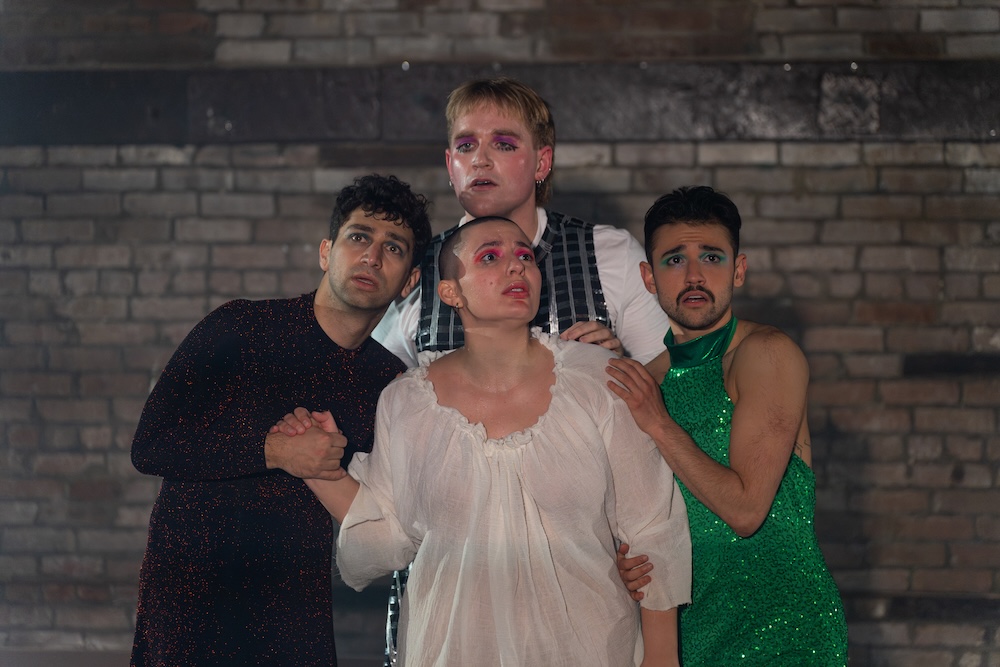
Travis Amiel, Corimo Pori, Nina Lucia Rodriguez, and Arzu Salmanl. Photo: Jose Miranda (@pelenguino)
Then we’re in a nightclub sequence set to an increasingly deranged remix of Chappell Roan’s “Good Luck Babe.” Spinning lights and clownery create the distinct feeling of a rave at an abandoned carnival fairground. We watch the besties endeavor to leave their bodies behind and disappear into the dance floor itself. “Don’t forget that you’re happy,” someone repeats over and over.
The percolating feelings of dread bubble higher to the surface: mortality has entered the chat. Everyone expresses a pervasive sense of “weltschmerz” (world-weariness) that leaves the besties feeling isolated, even “extraterrestrial.” Carrie Bradshaw, in voiceover, expounds the benefits of pessimism. A Spongebob sound clip extols the passage of time: it’s “two thousand years later…” and the besties have aged instantly, bedecked in gray wigs. They talk about death and continental breakfasts.
We jump through another portal, and Nina is trip-sitting the other besties in the woods in exchange for a Friendly’s sundae with extra hot fudge. She tells an ominous bedtime story about herself as a young girl, accompanied by slide-projected storybook cutouts, when her storybook catches fire — courtesy of illusions designer Reuven Glezer.
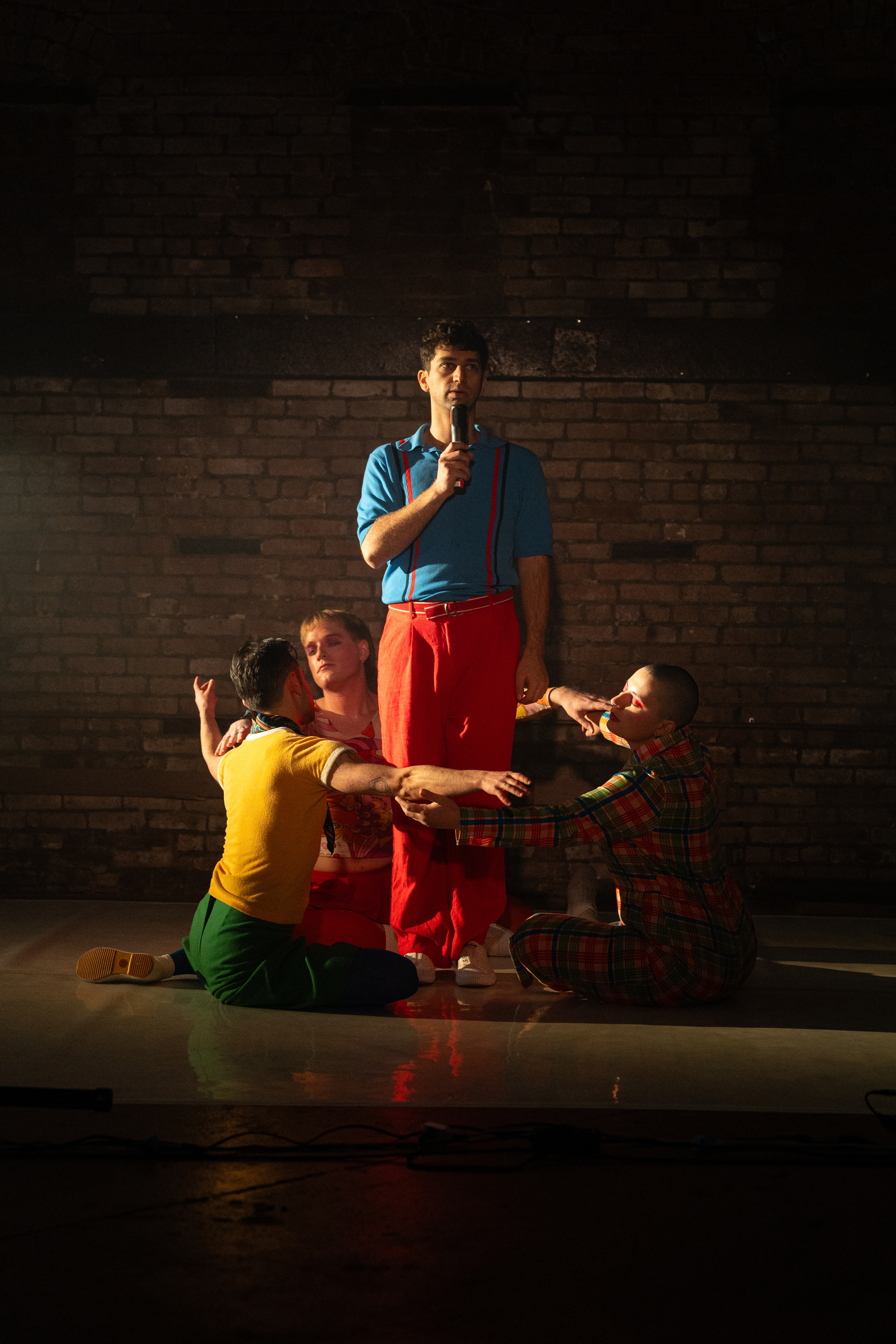
Travis Amiel (standing) with Arzu Salman, Cosimo Pori, and Nina Lucia Rodriguezl. Photo: Jose Miranda (@pelenguino)
Michael Bublé croons about being home for Christmas in a moment that seems to stretch on forever, trapping us in Christmas’s eternal waiting room, until a prank can of snakes explodes. One by one, everyone devours chocolate chip cookies with a feral sensuality. Nina returns in her blonde wig and implores the audience through song to “smiwe,” though their heart is “bweaking,” a moment that’s as silly and light as it is genuinely wrought with feeling: Nina, previously denied her Friendly’s sundae, is tired of being the odd one out. The gloves come off and the glitter mini dresses come on, just in time for the threat of religion to emerge as Travis does the “Apple” dance with a pair of devils. Now the movement is prancing and lewd, the battle between good and evil vampirically underscored by Toccata and Fugue in D Minor. It’s a flitting duet in a canon; it’s a journey of mental anguish.
Nina drinks the milk that turns her into a burlesque performer, and as she bumps, grinds, and bend-and-snaps to Sweet Charity’s “Big Spender,” a wig swinging from the backside of her topless leotard, she is gleefully raw and devoid of any coyness. She dances herself right into a breakdown as a voiceover examines the sociopolitical weight of how race permits or forbids “innocent” recreational drug use versus incarceration. Overcome, Nina vomits into the signature Broadway Cares/Equity Fights Aids red collection bucket. To cleanse her, the other besties baptise her in a kiddie pool under colorful watering cans, and dress her gently in a clean, white nightshirt as she’s lifted, Christ-like.
The piece ends much as it began, with another day at the beach. This time the kite is Nina’s: a peace offering, perhaps, or a key to belonging. The other three stand swaddled in a shared oversized t-shirt, and she looks on, beguiling, but apart. The kite flies peacefully overhead.
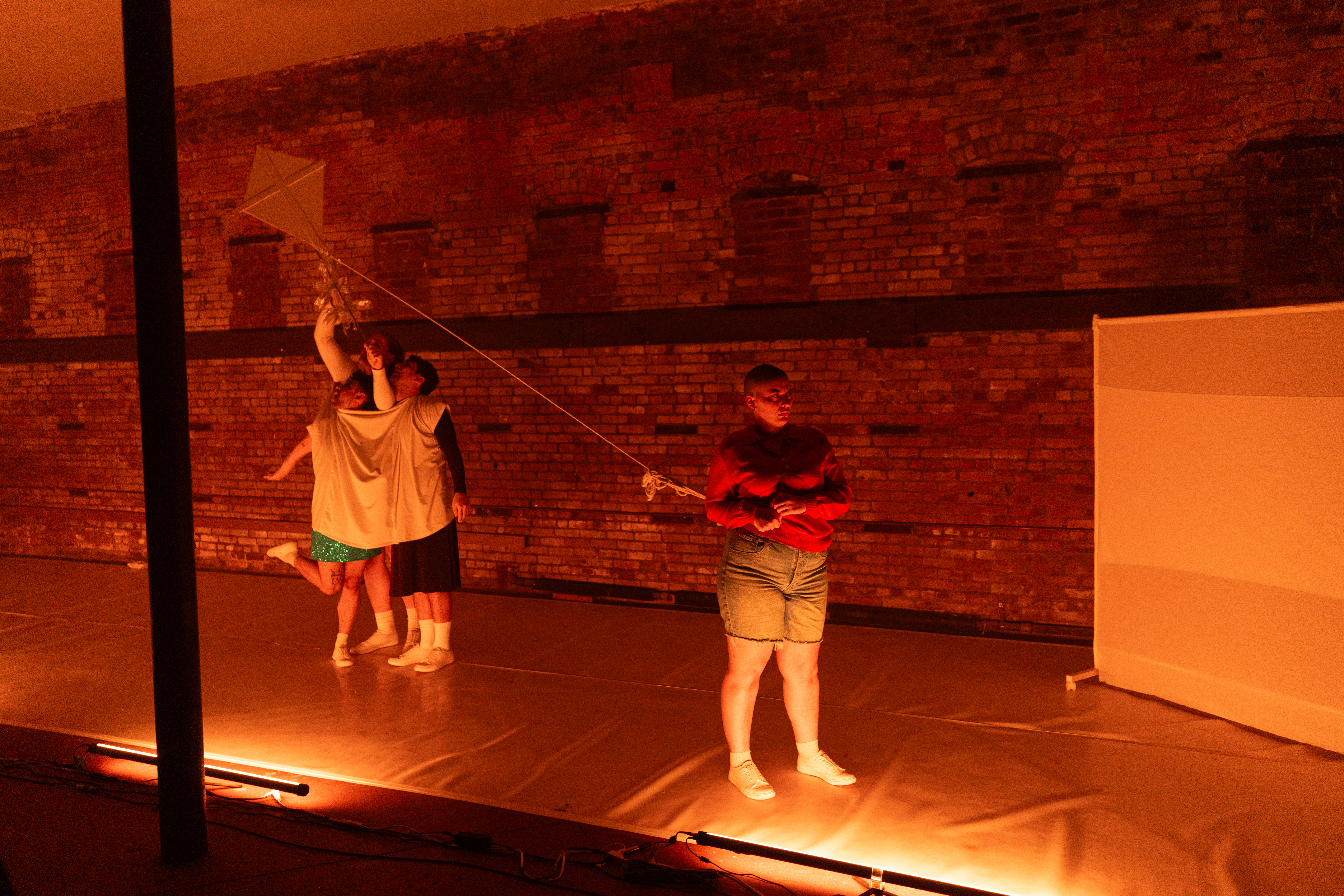
Arzu Salman, Cosimo Pori, Travis Amiel, and Nina Lucia Rodriguezl. Photo: Jose Miranda (@pelenguino)
Das Rauschgift is a metaphor for all that can befall you, both beautiful and terrible, on a night out. It’s a gnostic fable about the divine power of friendship and Taco Bell Cantina that summarizes itself in the line: “Every second is both precious and useless while I wait around for an unknown future.”
What do we do with the time that we’re given, and how do we walk the very fine line between utterly wasting it and filling it to the fullest? As all of us living atop the “blood-soaked red carpet” known as America grapple with these maddeningly mundane questions, battling the inverses of addiction and discipline and trying to reject the stark rigidity of either option, can we truly dance our way through it? Is it possible for everyone to have fun at the same time? More than answering these questions, Das Rauschgift emphasizes the necessity that we keep asking, dancing, and clinging tight to the dream of pleasure.