

Related Features
IMPRESSIONS: Lyon Opera Ballet in Merce Cunningham’s “BIPED” and Christos Papadopoulos’ “Mycelium”
IMPRESSIONS: Daniel Léveillé Danse in "Amour, acide et noix" at NYU Skirball
IMPRESSIONS: Jan Martens Presents "The Dog Days Are Over 2.0" at NYU Skirball

By Catherine Tharin
View Profile |
More From This Author
Published on March 7, 2026
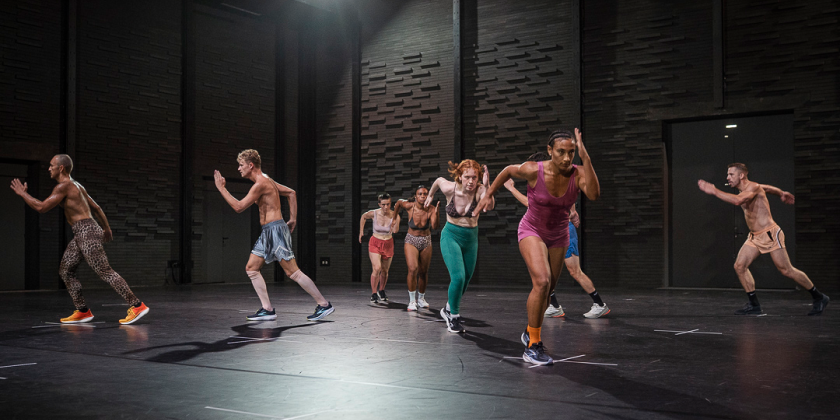
"The Dog Days Are Over 2.0" by Jan Martens. Photo: Stefanie Nash
Presented by Dance Reflections by Van Cleef & Arpels Festival
Presented by Dance Reflections by Van Cleef & Arpels Festival
The Dog Days Are Over 2.0
Choreography: Jan Martens
Performers (eight out of these dancers): Pierre Bastin, Camilla Bundel, Jim Buskens, Zoë Chungong, Simon Lelievre, Florence Lenon, Elisha Mercelina, Dan Mussett, Pierre Adrien Touret, Zora Westbroek, Maisie Woodford, Paolo Yao
Dramaturgy: Renée Coprij
Costume Styling 2025: Sofie Durnez
Lighting Design: Jan Fedinger
Physiotherapy and Osteopathy: Fourward Gent, Inge Haeyaert, Lode Verreyen
NYU Skirball, 566 LaGuardia Place, New York, NY
February 25 - 26, 2026
Eight dancers stand against the upstage wall of the fully exposed stage of NYU Skirball Theater. The brick wall and structural elements are painted entirely black, and remain visible. As the audience settles, the dancers in The Dog Days Are Over 2.0, shift their weight and lightly warm up before determinedly walking forward together to put on their sneakers, lined up at the front of the stage. They take their time to tie the laces, balancing on one leg or sitting briefly on the floor. All standing, they begin to bounce.
The first bounce is minimal, a soft bend of the knees that barely lifts the heels from the floor. The ensuing repetition resembles movement from an aerobics class that is steady, functional, and almost instructional. A voice calls out, And 1, and the bounce becomes collective as they travel forward and back in small increments, then side to side. Numbers are spoken evenly — Count 6, 7, and then later 50, 80, — cueing how many sets of bounces have passed. Up to this point, I found myself counting with them. 10,000 steps have nothing on this group!
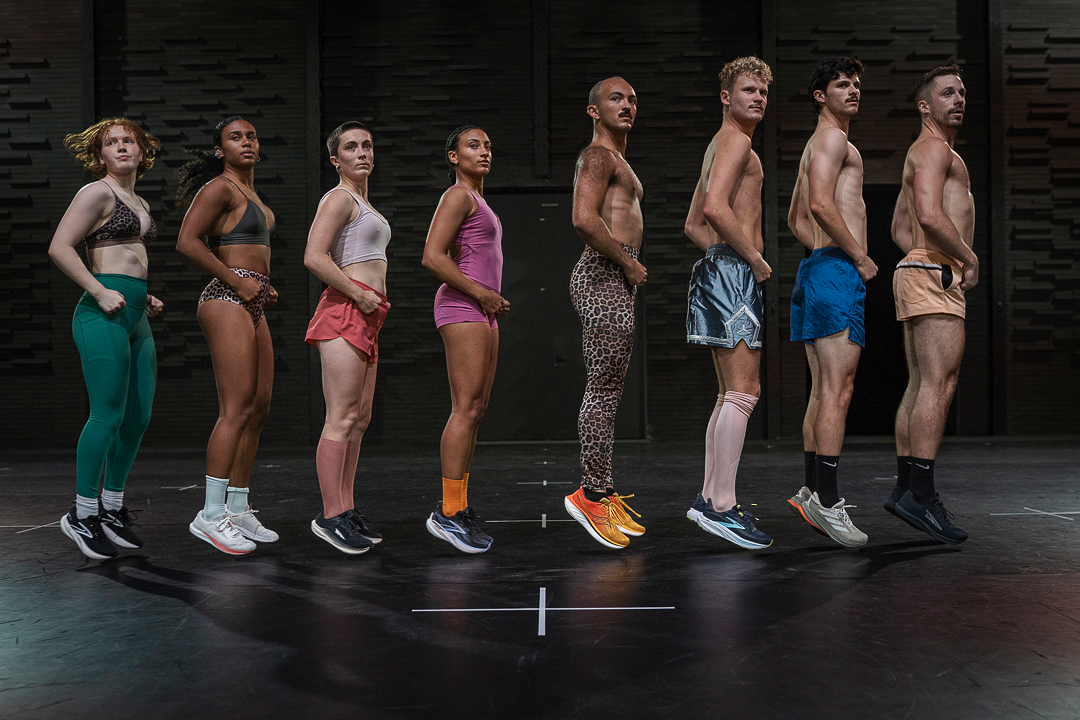
The line compresses, until shoulders touch and angle onto a diagonal with feet tapping. A male dancer in leopard pants slips between two women. The formation reorganizes without breaking the rhythm. A woman in a pink unitard shifts between two men. The group travels upstage, then curves into an arc that traces a wide C shape. White crosshatch markings form a grid on the floor and assist with spacing as the dancers move.
For most of the performance, the lighting remains bright and even, illuminating the dancers and audience alike. Later, in an abrupt shift, it contracts to a wide spotlight leaving the audience in darkness. This alters the atmosphere without affecting the movement.
The choreography expands through accumulation. The dancers face stage left, then upstage, then return to face front to the sound of their footfalls and the squeaks of their sneakers. They join hands, a notable development, forming a circle that rotates clockwise and counterclockwise before releasing back into lines. Diagonals stretch across the stage and contract again. A lunging run for four counts dissolves back into the bouncing repetition. Arms extend downward with fingers tightly together. Fists press into the pelvis. The tempo increases. Two dancers initiate movement with a thrust of the head, the body following. Knee lifts appear, hips turn, arms slice forward and back, and triplet rhythms layer into the steady bounce as the vocabulary develops. Just when you think they couldn’t possibly go on bouncing, they defy expectation and jump in big Xs and leap forward.
Approximately three quarters of the way through, each dancer introduces a three-count individual phrase while maintaining the shared tempo. The stage fills with simultaneous variations that remain synchronized in rhythm, personal accents contained within the collective timing. After several cycles, the dancers draw their phrases back into full unison, restoring the line without altering the underlying pulse.
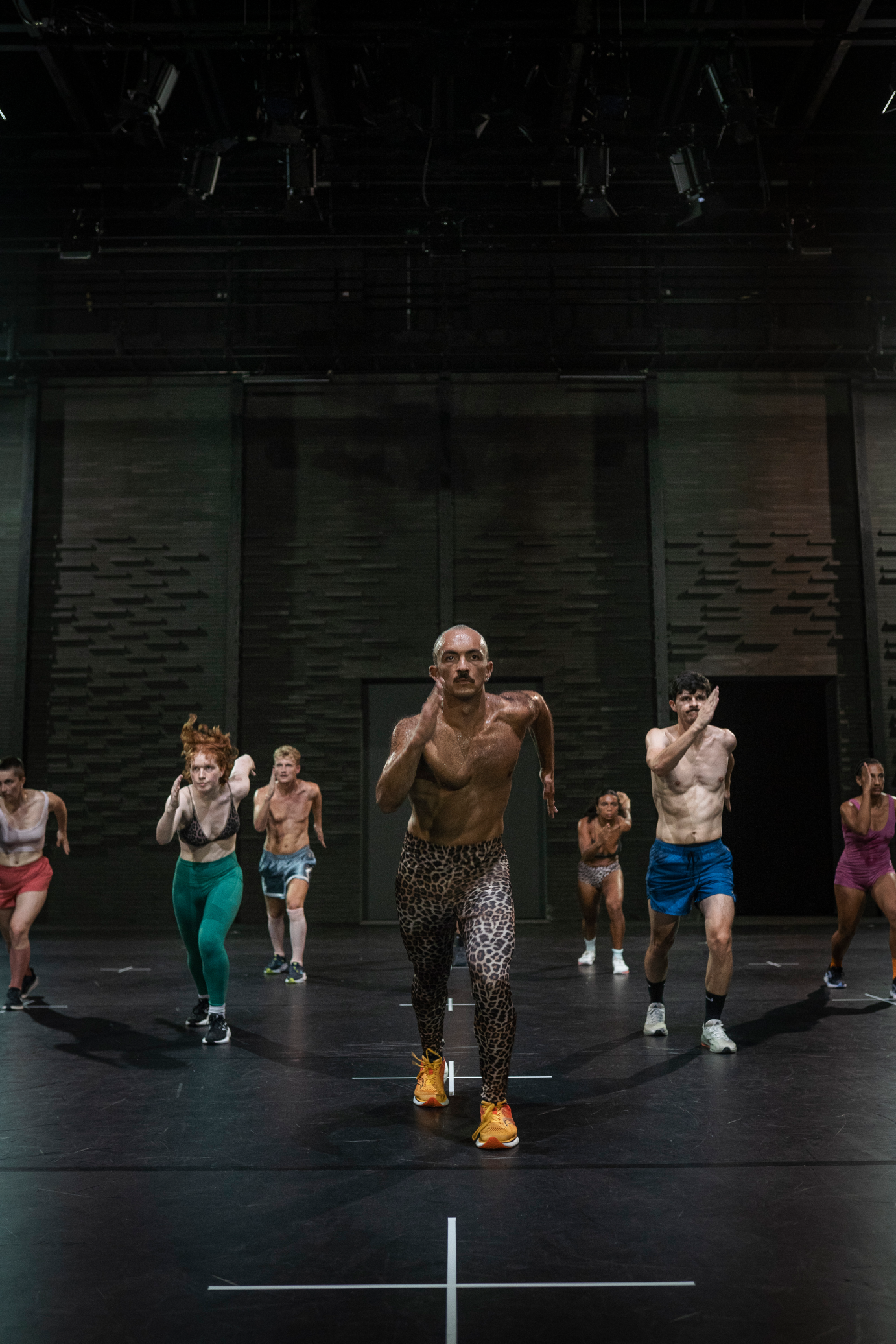
Choreographic decisions interrupt without explanation. A softly played Spanish guitar recording becomes increasingly audible. Seeming to arrive from another world, the sound washes over the choreography.
A red-headed dancer in green leggings leaves the stage without warning, a disruptive non sequitur. She seems depleted and exits with a casualness that contrasts with the formal rigor of the movement. Later she returns carrying a chair and sits quietly watching until she calls out counts. At one point, the dancers leave a space for her in their circle, but she doesn’t join. And the bounce continues.
In the final image, the dancers stand in a line at the stage’s edge and the light travels across their bodies in horizontal bands, illuminating feet, then knees, pelvis, chest, and finally faces before fading to black.
Originally created in 2014, and revived with a new cast, The Dog Days Are Over 2.0 embodies structural intensity and communal endurance. For 70 minutes, choreographer Jan Martens takes us for a ride. The piece suggests that life continues, with its unexpected turns, to the steady beat of our hearts. The viewer is left marveling at the dancers’ precision, stamina, discipline, control, and will, as well as taking satisfaction in the choreographic completeness and rhythmic thrill of the work.