

Related Features

Dance News: Danspace Project To Present The U.S. Premiere of Joan Jonas's Immersive Lecture-Performance "Moving Off the Land" This June 14-16

Eiko Otake: A Body in Places - Part IV
IMPRESSIONS: Joan Jonas Presents "The Juniper Tree" at Danspace Project's "Platform 2026: Secret Gardens"

By Kate Purdum
View Profile |
More From This Author
Published on May 13, 2026
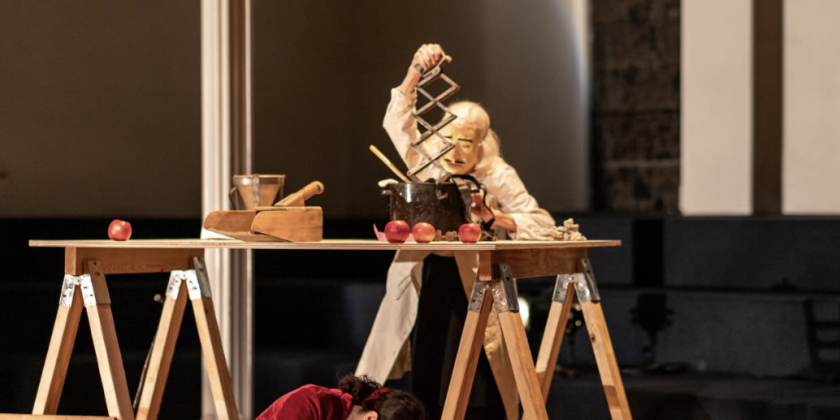
Joan Jonas and Lucy Mullican. Photo: Rachel Keane
Co-curated by Judy Hussie Taylor and Seta Morton
Performers: Joan Jonas and Lucy Mullican // Soundtrack by: Joan Jonas
Original Performers (1976): Tim Burns, Simone Forti, Pooh Kaye, Lindzee Smith, Linda Zadikian
Recorded essay by: Mark Von Schlegell // Recorded “Chirping Sparrow” poem written and read by: Susan Howe // Italian folk songs contributed and sung by: Simone Forti
Lighting Designer: Ben Demarest // Crew: Ryn Doherty (props), Jake Fischer (sound), Niko Tsocanos, Paula Longendyke, Raquel Nicolas, Beth Zopf
St. Mark’s Church In-the-Bowery
March 26 - 28, 2026
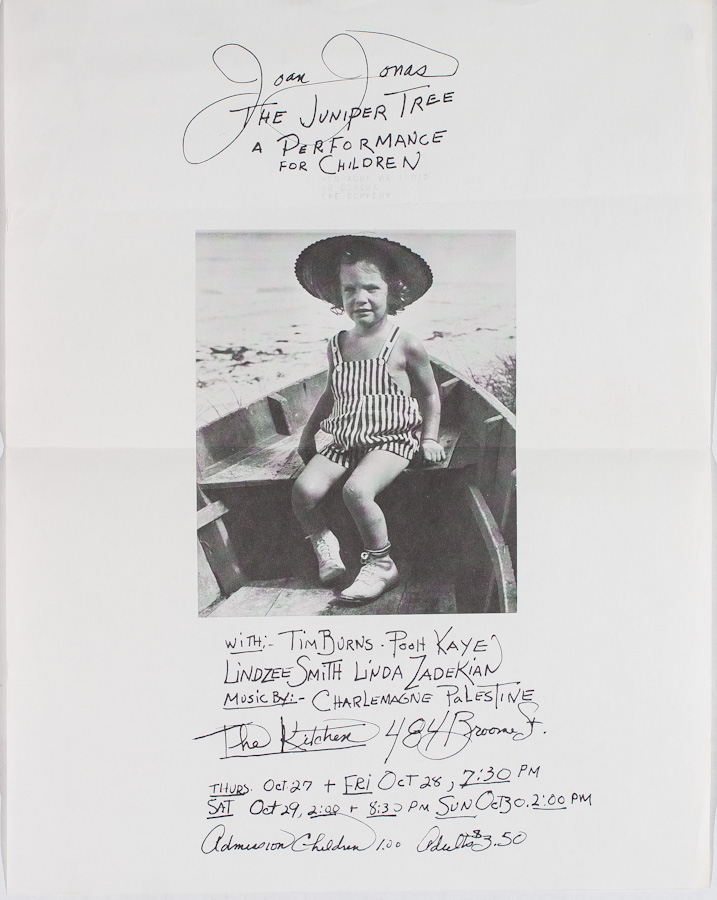
Joan Jonas, small yet magnetically stoic at 89, stands beneath a projected photograph of herself in even-smaller childhood, on the beach with a pail and a shovel. The photo is the centerpiece of the original 1976 flyer for The Juniper Tree, splashed larger than life in all its hand-scrawled glory across the altar wall of St. Mark’s Church In-the-Bowery. Memory dwarfs life in this tableau, an apt beginning to this performance — part-retelling, part-remaking — of a fable of life and death.
Jonas enters the space wearing a long, blindingly white button-down, almost a labcoat, over a black dress with white shoes and socks. With a firm and open voice, she tells us the story of how The Juniper Tree came to be 50 years ago in this very space. Psychologist Bruno Bettelheim, whose watershed 1976 book, The Uses of Enchantment, examined the fortifying effects of fairy tales on developing minds, inspired Jonas to develop a children’s show with darkly adult themes. Music, specifically Italian folk songs sung by Simone Forti, became the work’s spine.
The Juniper Tree itself, a gory tale from the Grimm canon, was a suggestion from Jonas’s friend Susan Howe, whose young son Mark loved the story. Mark, now grown, reads his essay on the story and its place in his childhood in voiceover. Biologically, he says, every cell in his body has turned over and changed since he first read “The Juniper Tree,” but the story’s vision of justice, refracted through the lens of his upbringing in 1970s New York, forged something indelible in him. His mother Susan reads a poem, also in voiceover, complete with the sound of rustling pages and birdsong. This reflective prelude feels like reading the preface to a re-issue of a great work of literature.
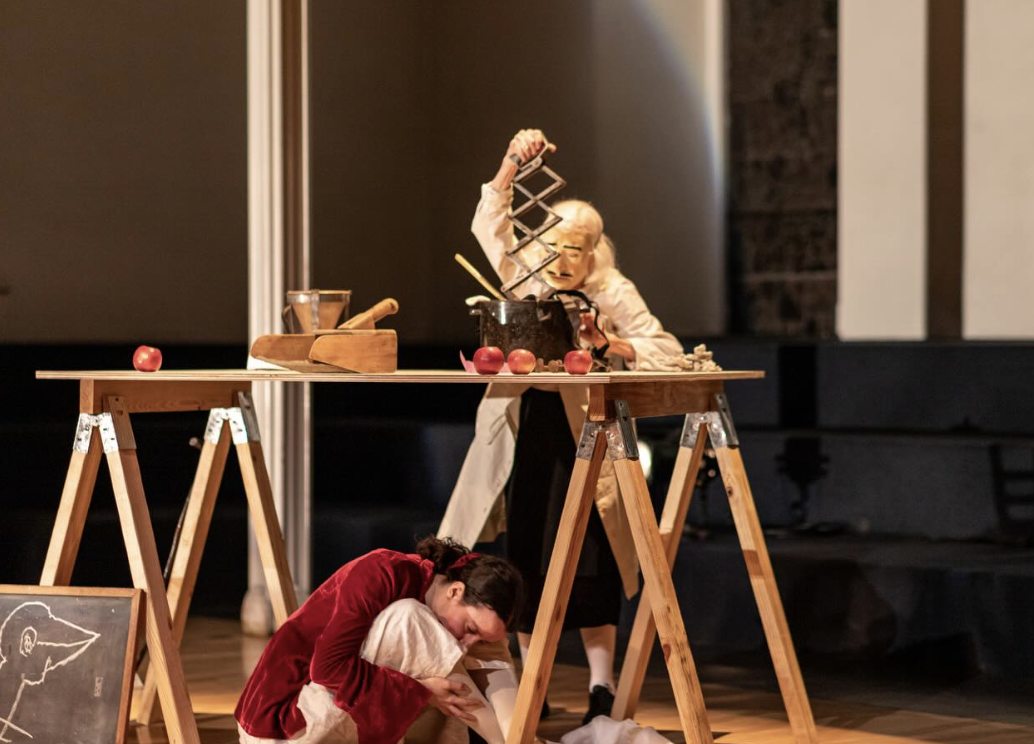
The performance that follows is a combination of narration and choreography that plays like memory. The stage is strewn with objects: loose squares of fabric, empty frames, a ladder, a table on sawhorses, blood red apples. There’s a hushed, casual atmosphere in the room, with the first several rows of the audience seated on the floor. Jonas’s voice, strong and clear, narrates the text of the story as she and a younger dancer, Lucy Mullican, play-act the events. The projector flips through photos of past performances, black and white shadows of dancers snaking through churches, theaters, and galleries, painting the walls and stringing strange objects from the rafters.
The Juniper Tree centers on a woman and her husband in desperate want of a child “as red as blood and as white as snow.” After eating the berries from their juniper tree, the woman gives birth to the son of her dreams, but she loves him so much that she grows sick and dies. Her widower buries her under the juniper tree and takes a new wife, with whom he has a baby girl, Marlinchen. Greedily, seeking the family’s fortune for her daughter alone, the stepmother lures the little boy by placing an apple in a heavy trunk, and when he reaches in to take it, she slams the lid on his head, decapitating him. The stepmother replaces the boy’s head on his body and poses him until he is disturbed by Marlinchen, who believes she has killed her brother by accident. To cover her guilt, the stepmother turns the boy into black pudding and feeds it to his father, claiming the boy has run away. Tearfully, Marlinchen plants his bones in the family garden, under the juniper tree, where he grows into a bird who comes back to drop a heavy stone on the stepmother, crushing her, which transforms him back into a boy.
The roles shared by the two performers are nebulous and elastic, and they remain ever somehow themselves. Jonas pares an apple as the boy’s mother and drops the slices, plunk-plunk-plunk. She and Mullican play a version of jump rope with a set of heavy wooden beads, which cast solemn, ominous shadows, pendulous and regular like the ticking of a clock. A shrill, disharmonious recording of “You Are My Sunshine” screeches through the speakers, as if being sung on an inhale, as Jonas wildly lip-syncs, painting red splotches on a white canvas that congeal into a heart shape. Jonas scoops a small grey dog out of the audience and dances with it to soft rock music while Mullican, in a white dress and a red scrunchie, shimmies up the ladder — the juniper tree — and perches lightly on its upper rungs. Recorded dog yelps fade into Jonas ringing a bell, and then to Forti singing in throaty, mournful Italian. To stage the mother’s death, Mullican climbs under a white sheet as Jonas ritually shakes a gourd in mourning. Mullican removes her sheet and slinks into a red velvet jacket plucked from a trunk of playthings, now the stepmother.
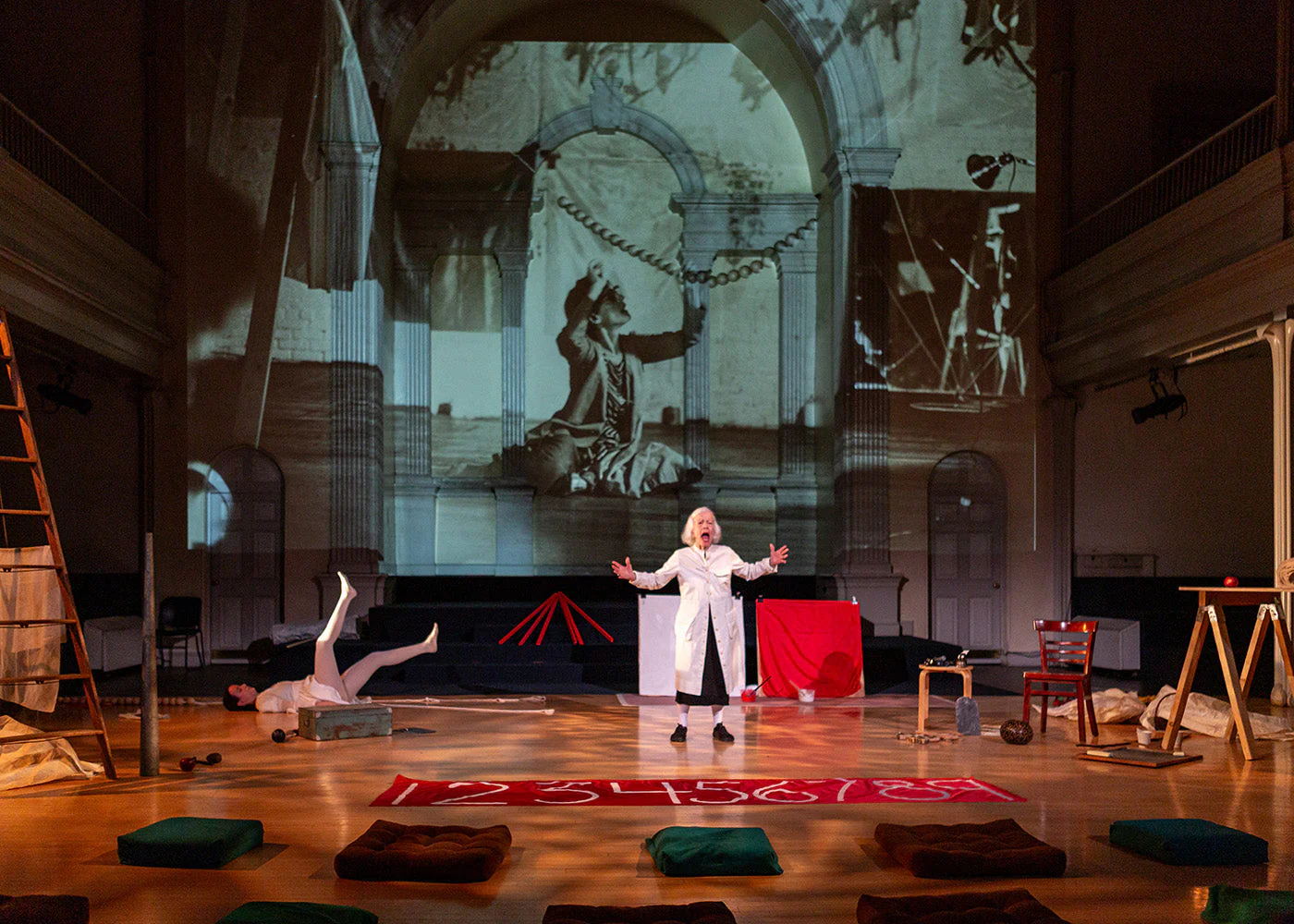
Jonas stands visible behind a translucent white flag (surrender), then, describing the stepmother’s hatred for the boy, she moves to the red flag, broiling with anger. With violent strokes, Jonas defaces her earlier painting, turning the heart into a face as the stepmother (Mullican) dons a white papier-maché mask, playing with dolls at the foot of the trunk. Jonas rings her bell more frantically, and Forti’s singing mingles with a soundscape of apple chewing and rustling. The text describing the stepmother's violent greed is repeated, doubled, then tripled for emphasis.
Jonas becomes the stepmother and Mullican her precious daughter Marlinchen, and Jonas chops the boy to bits on the sawhorse table while Marlinchen cowers beneath it, flinching with each hit of the carving knife. With a new mask — a sunken, skeletal face — Jonas is the father, too, who greedily devours the black pudding made from his son. The boy’s bones are soon buried under the juniper tree by Marlinchen, and as he is turned into a bird, Mullican dons a beautiful blue and white robe, unfurling a scroll with a calligraphic illustration of a tall, supple tree while Jonas plays birdcalls on a whistle toy. The bird visits his father and half sister, bestowing joy, delight, and gifts, and then the crushing and fatal blow to his stepmother as he drops a large, round millstone from the sky. Mullican as Marlinchen once more, freed from the burdens of evil in her family, scoops the puppy from the audience: it is her brother, returned from the dead and no longer a bird but a real boy, puppy-soft. She and Jonas bob and weave gently in warm, red light—the brother is saved. A softly ringing bell follows the performers as they turn upstage and disappear.
In the end, The Juniper Tree offers a meditation on the arc of the moral universe’s long bend towards justice. The innocent boy is redeemed through transformative, violent comeuppance as his bird-self kills the wicked stepmother, but his own mother, whose only failure was in her very death, does not live again. But, as is the way in these tales, the boy is fortified by his journey through life and death, grateful to be with his father and sister as they begin to mend their lives. Moreover, the telling of the story is poetic, gentle, and graceful, even in its darkest moments. Perhaps the message to audiences of any age is more suggestive than declarative: though things might go horribly wrong, you can find peace in the belief that suffering will indeed find those who have done enough wrong to bring it on themselves.
This gentle message takes on a new gravity in light of The Juniper Tree’s fiftieth anniversary: life is long, and things have a way of coming back around. Jonas’s evident gratitude for the endurance of this piece, her audience, and a space to dance was moving to behold. We are all we have in the time we’re given — let us be together and make believe we are able to be strong, until we are.