




AUDIENCE REVIEW: The Room We Carry
Company:
NVA & Guests
Performance Date:
November 5-7, 2026
Freeform Review:
“The Room We Carry” by Nicole von Arx (in collaboration with the cast)
Date Attended: November 6th, 2026 at 7:30PM
Company: NVA & Guests
Dancers: Caitlin Taylor, Gabe Katz, Dareon Blowe, Juan Carlos Franquiz II, and Michael Greenberg
Music: Nicolas Jaar, Benjamin Louis Brody and Eliot Krimsky
Projection Design: Amanda Hameline
Understudies: Derek Lee, Thy-Lan Alcalay
Review by Richard Sayama
Internationally renowned choreographer Nicole von Arx presented “The Room We Carry” at 3AM Theater in Astoria, Queens, a choreographic masterpiece. She describes the evening-length work as a dance-theater duology that draws upon inspiration from novel Jugen ohne Gott (Youth Without God) by Ödön von Horváth, award winning documentary Mr. Nobody Against Putin, and award winning miniseries Adolescence. “The Room We Carry” transcends beyond the duality of dance and theater, creating an ethnography illuminating a reality of censorship and surveillance upon education and its affectation on youth development.
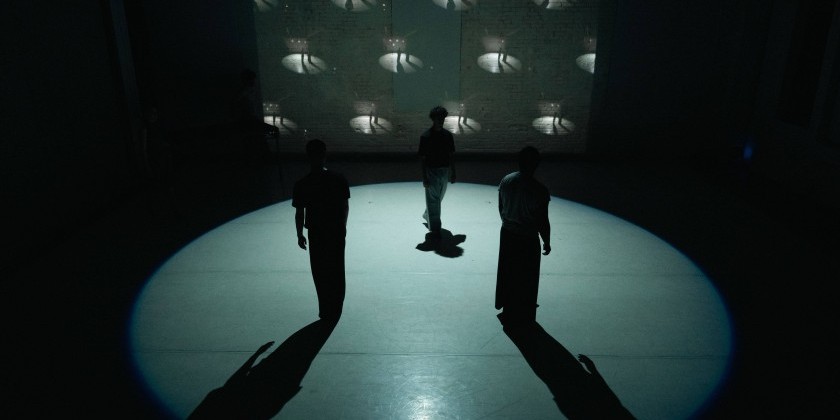
Before the piece officially begins, von Arx invites us into a dimly-lit, intriguing space where the five performers inhabit the stage, each attending to their own tasks: leaning against a wall, writing on a paper, breathing into a mic. “The Room We Carry” projects texts onto the white brick wall in the upstage, revealing what appears to be a conversation between two people. It felt like I was witnessing a covert dialogue before the commencement of a secret mission. This subtle but effective obscurity heightens the suspense.
I have seen von Arx effectively use text and spoken words, as in her work “Cry Wolf” (2024-2025) as a means of engaging with dance, an art form (particularly contemporary dance) that is often difficult to make meaning of. What distinguishes von Arx from other artists is her invitation for audiences to generate their own interpretation from the comprehensible but indirect texts. Words are powerful in conveying meaning in a prescriptive way that can sometimes didactically impose meaning onto audiences. “The Room We Carry” transcribes the literalness of the concept of censorship and surveillance and allows audiences to actively engage and reshape their interpretation as the piece progresses.
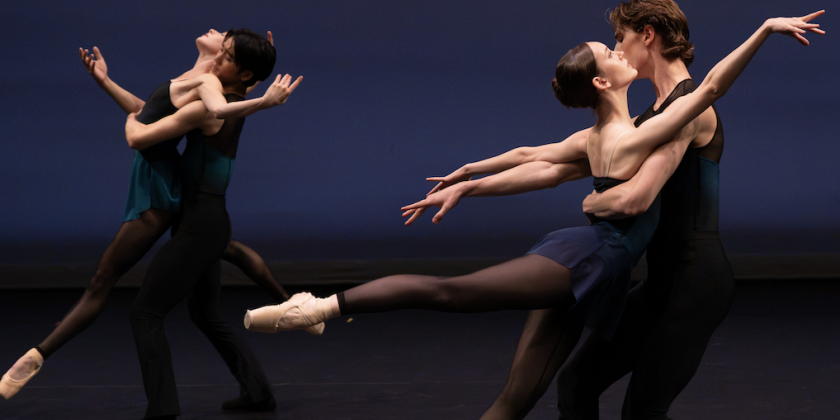
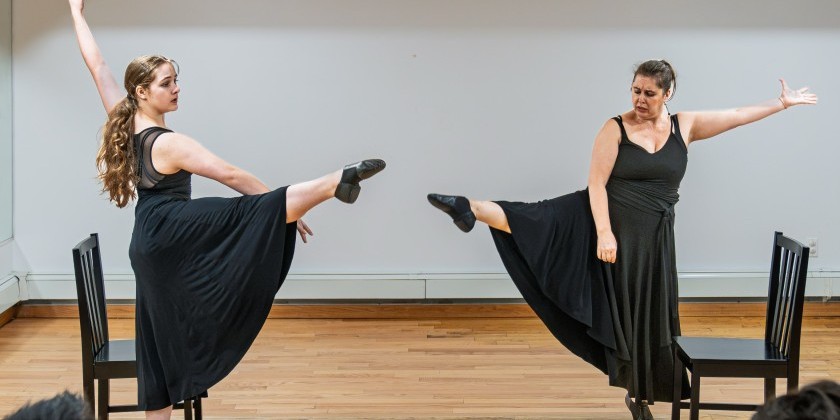
von Arx moves the narrative along with eloquent and tactile choreography, masterfully performed by the five dancers. As someone who has had the privilege of embodying von Arx’s movement vocabulary through classes and choreography, I appreciate the intentful gaze and gestures that bring humanity into contemporary forms. The ocular magnetization into the palm of the hands, the breath that suspends the body before spilling into the ground, and the inscription of limbs like calligraphy on a sheet of paper. There’s a simplicity behind the intricacy and multidimensional choreography that makes von Arx’s movement accessible and engaging to witnesses that may not share the same experiences of dance.
Each dancer synthesizes their individual style with von Arx’s movement vocabulary with grace. Caitlin Taylor has a super power of changing the environment she inhabits. One moment you think she’s effortlessly spinning on ice, and the next she moves fluidly through thick air with resistance. Dareon Blowe redefines partnering with Caitlyn with his effortless weight share and support. It is, of course, a testament to Caitlyn as a partner. But as someone who also partners in dance, I can appreciate Blowe’s expertise in weight transfers. His movement is proof that with great power can also come great care. Michael Greenberg has a smooth and effortless approach to his movement quality. It then surprises me when his dynamic becomes explosive, like a leaf suddenly changing its trajectory from a gust of wind. Gabe Katz brings care and tenderness to viewers through his seamless flow. But he also knows how to shift the emotional tone through a subtle change of expression that communicates beyond just the gaze. Juan Carlos Franquiz II also shares a similar luscious quality but surprises me with moments of abandoning his weight to gravity. There’s beauty in physically seeing him yield and recover in and out of the floor.
The unison and canonized choreography develops into a conversation between the audience and Katz. He greets us in a casual manner, asking us how we were feeling, and even acknowledges some familiar faces. Just like an educator who integrates student participation to resist didacticism, Katz empowers us to have a role in the narrative. He leaves with an invitation to revisit memories and emotions from high school as the stage timewarps back with performers projecting youthful energy.
The breaking of the fourth wall is further utilized when a phone projects a live recording of Michael Greenberg sitting between two audience members in the front row. Like Katz, Greenberg settles into a reflection on his high school memories in dialogue with his adjacent audience members. However, the projection of Greenberg’s conversation with audience members onto the white brick wall for all to see foreshadows an invisible but real issue of surveillance and consent. It was entertaining to see real-time behaviors by audience members, where some physically moved out of frame, and some who accepted their fate of exposure. The tone of the evening shifts once again when Greenberg introduces the topic of bullying, which adds to the ominous tone.
The projected conversation from the beginning of the piece returns. Though ambiguous at first, I contemplate that the subject being discussed in secret is actually about us, the audience. The caring and inviting choreography, scenes, and anecdotes by the dancers that provided a sense of care and empowerment to the audience began to dissolve through this realization. The dancers too were left without control in how they were able carry the room as educators and presenters. This interpretation gave me the chills, knowing that I had no control within the surveillance of some omnipresent figure that was prescribing unconsented censorship and policies.
A highlight of the evening was when numerous projections of the live performance illuminate against the back wall. We view three rows of screens, each row containing four. The aesthetic is reminiscent of a large screen used in security surveillance that views multiple rooms. However, in this case, it was all projecting the choreography - but with a slight twist. Each of the 12 screens had a slight lag from the real-time projection. There was one that reflected in real time, and the others were increasingly behind in timing: 2 seconds behind, 5 seconds, 15 seconds, etc. I was frustrated by this ocular negotiation because I wanted to enjoy the ephemerality of the live movement, but there was a large presence that was constantly demanding the retention of the choreography. Like a manifesto in many communist traditions, I was being forced to digest the same information repeatedly until it became a part of my identity. A huge round of applause to projection designer Amanda Hameline for their brilliant use of projection throughout the show.
“The Room We Carry” evocatively portrays the responsibility of not only teachers but adults, and their capacity to shape the future through educating the next generation. As an educator myself, I empathize with the privilege and power of carrying a room full of students. There is great potential to empower and cultivate students. However what happens when the rules of what can be taught or said becomes censored by the politics of education? von Arx’s research through film, novels, interviews, and autobiographical empiricism from her collaborators, beautifully comments on this current issue of censorship and surveillance. The incorporation of personal anecdotes from the performers made the piece even more relatable and universal.
von Arx is truly a master at storytelling through dance-theater. Her multidisciplinary inventions of dance, props, spoken word, digital dance, lighting, and set design never fails to create an experience that is mesmerizing and profound. Like a movie or novel that begins with ambiguity and obscurity, there is immense satisfaction in the epiphany when all the missing pieces come together at the end. Unlike many performances where I have a sense of expectation for what I’m about to witness, von Arx always surprises me with her playful but haunting innuendos. Though you may feel safe in the comfort behind the fourth wall, it is clear that von Arx always considers audiences as equal participants of the show.
However von Arx also shows great care in the emotional experience of audiences. Maura Nguyen Donohue, Asian American artist and Chair of Dance at Hunter college, once stated that “dancers reflect the reality that is today, and dream of a future that could be” (2026). von Arx’s publication of knowledge that draws upon numerous works and scholars brings her to the forefront of contemporary art. Though she reflects the frightful realities, she leaves audiences with optimism and hope for the future. Like her previous work “Cry Wolf” (2024-2025), “The Room We Carry” is another immersive experience that everyone will benefit from witnessing.
Date: November 8th, 2026
Photo Credit:
Stepan Liubimov