


More Reviews
It’s Not Trampoline Camp: STREB Extreme Action’s Do Not Try This at Home! at the New Victory Theater.
SHINDIG
AUDIENCE REVIEW: Fault Lines: Where the Body Holds Its Ground
Company:
Kaochi Lee
Performance Date:
15 November 2026
Freeform Review:
A woman sits on the edge of a battered frame, head bowed, hands pressed to her chest. Behind her, a rust-coloured panel has been ripped open. The frame still stands, though it offers little comfort. It is a strong image of a person trying to make herself small in a space that has already fallen apart.
Kaochi Lee's Fault Lines, created in 2023, deals with the instinct to protect ourselves and the damage that can follow when that instinct takes over. Lee works in a distinctly physical, non-narrative language. The figures are defined through their gestures, their responses to one another and their place within the set. We are left to make sense of their inner lives from what their bodies reveal.
Dance is already an abstract language, and Lee takes that abstraction a stage further. A tightened shoulder or a sudden shift of weight has to carry the feeling that dialogue might otherwise explain. For anyone unfamiliar with contemporary choreography, the result may seem elusive. There is plenty here to look at, though, and Lee's willingness to trust movement with such difficult material is one of the work's attractions. It is an adventurous way of making dance-theatre, with room for the audience's own associations.
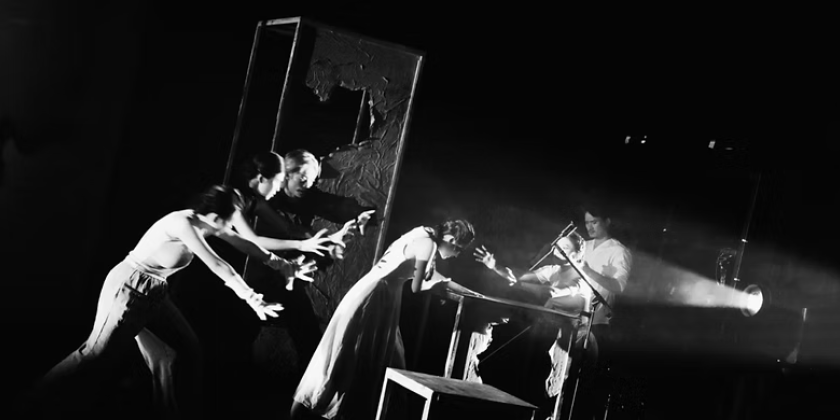
The set is central to Lee's thinking. Tall rectangular structures, with torn surfaces and exposed edges, divide the stage into a series of irregular spaces. They look half-built and half-demolished, like pieces of a room whose purpose has been forgotten. Their placement matters. A performer can appear sheltered by a frame from one viewpoint and uncomfortably exposed from another. Empty sections allow us to look straight through, so that distance and proximity can shift within a single picture.
Lee has a particularly good eye for this kind of composition. He knows how to use the straight lines of the scenery against the curves and angles of a moving body. In the image of the seated woman, the structure looms above her; the small, guarded shape of her body seems all the more fragile. The physical relationship tells us something before any larger explanation is needed.
Another striking encounter places two dancers facing each other. The man extends a leg towards the woman, whose raised arms meet the threat. The shape is sharp and awkward. His balance looks precarious; her defence requires her to hold her ground. The interest comes from the detail of their positions. She is taking space and risking his stability at the same time. He is resisting while staying firmly involved in the encounter. Lee makes a psychological situation readable through weight, direction and the simple question of who can move where.
Such choices show a choreographer alert to the expressive possibilities of movement. Lee pays attention to the moment a familiar action becomes strange. A gesture of protection may harden into withdrawal. Reaching towards somebody can expose an uncertainty that words would tidy away. His physical vocabulary seems grounded in recognisable impulses, even when the meaning remains unsettled.
The production also makes effective use of fabric. In one image, a long translucent sheet stretches across the stage under a wash of blue light. Dancers appear beneath and behind it, their outlines softened and partly swallowed by the material. Alongside the severity of the damaged frames, the fabric brings an unexpected sense of motion and scale. It changes the texture of the whole stage picture. Lee clearly enjoys working with objects that can reshape the space around a dancer.
There is a discipline behind these visual decisions. The arrangement of the frames, the level of the bodies and the use of open areas all direct the eye. Lee treats stage design as part of h is choreographic material. That gives Fault Lines a distinctive theatrical character and suggests an artist interested in how movement can alter the meaning of a place.
The piece will ask more patience of viewers who prefer a clearly told story. Its broken structures and guarded figures point towards a recognisable emotional world, though the connections are left for us to discover. That openness feels deliberate. It is also where Lee's approach becomes most exciting, as the audience has to watch the body closely and decide what it sees.
Fault Lines offers a persuasive glimpse of Lee's creative instincts. His strength lies in spatial organisation and the careful handling of physical tension. He has a taste for bold stage images, and the ability to find feeling in the angle of a limb or the distance between two people. There is something promising in that combination. It gives him an unusually broad canvas for a work concerned with experiences that are often hard to put into words.