


More Audience Reviews
It’s Not Trampoline Camp: STREB Extreme Action’s Do Not Try This at Home! at the New Victory Theater.
SHINDIG
AUDIENCE REVIEW: Fault Lines: Where the Body Holds Its Ground
Company:
Kaochi Lee
Performance Date:
15 November 2026
Freeform Review:
A woman sits on the edge of a battered frame, her head lowered and hands pressed against her chest. Behind her, a rust-coloured panel has been torn open, leaving the structure exposed. Her body is folded inward, almost as though she is trying to disappear into the surrounding wreckage. It is an uncomfortable image, made more affecting by the stillness of the figure against the damaged set.
Created in 2023 , this dance theatre work choreographed and directed by dance artist Kaochi Lee in Penghao Theatre. Fault Lines explores self-protection, emotional insecurity and the difficulties of human relationships. There is no conventional storyline. Much of what happens is expressed through physical encounters, changes of weight and the relationships between bodies and their surroundings.
The movement vocabulary is firmly rooted in contemporary dance, with an emphasis on contraction, off-centre balance and the tension between release and resistance. Bodies bend, extend and fold back towards themselves. A movement may begin with a simple reach, only to be interrupted by a shift of weight or a sudden change in direction. The dancers seem caught between the impulse to move towards another person and the need to maintain their own space.
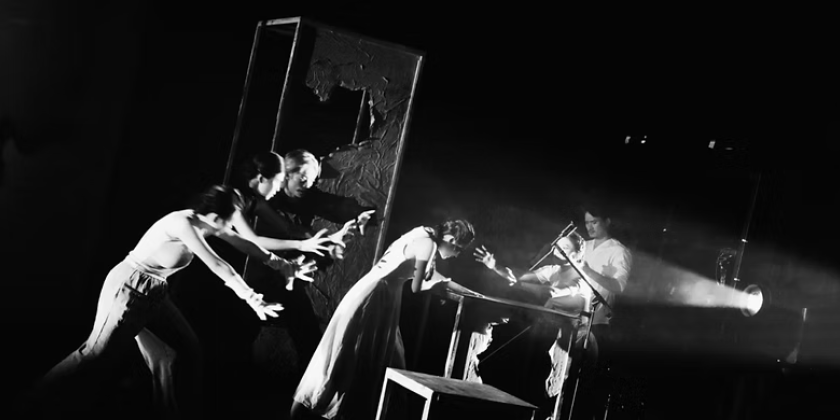
One particularly interesting moment involves two performers facing each other. The male dancer extends his leg towards the woman, who responds with raised arms. His extended position places considerable demand on his balance, while her upper body forms a defensive shape. The opposition between the two creates a strong physical image. Neither appears entirely in control of the encounter.
What makes this exchange effective is the way the dancers negotiate space. The extended leg restricts the woman's movement, but it also leaves the man physically vulnerable. Her response is both protective and confrontational. The tension is carried through their alignment, the direction of their limbs and the distribution of weight. There is little need for exaggerated facial expression when the bodies already communicate so much.
The choreography is at its most engaging in these moments of direct physical interaction. Small adjustments in posture can change the relationship between the performers. An arm held across the body suggests withdrawal; an extended limb creates distance or resistance. These are familiar movements, but their placement within a duet gives them greater significance.
The large rectangular frames that occupy the stage are equally important. Their distressed surfaces and exposed edges suggest a space that has been damaged or abandoned. The dancers move within and around these structures, sometimes appearing enclosed, sometimes exposed. The openings allow the audience to see through different sections of the set, creating overlapping perspectives and a sense of depth.
There is an interesting contrast between the rigid geometry of the structures and the irregular shapes made by the dancers. Curved backs, bent knees and extended limbs interrupt the straight lines of the scenery. The seated woman, surrounded by the much larger frame, is a particularly clear example of how the scale of the set can affect our perception of the body.
At other times, the production introduces softer visual elements. A long sheet of translucent fabric stretches across the stage under blue lighting, partially concealing the dancers beneath it. Their outlines become less distinct, and the movement takes on a different quality as the material alters what can be seen. It provides a welcome change from the hard edges and enclosed spaces that dominate the other images.
These visual elements are striking, although they occasionally raise a question about the balance between choreography and design. The frames and fabric establish an atmosphere so strongly that the movement can seem dependent on them for its emotional context. The physical material is most convincing when the relationships between the dancers remain readable without relying entirely on the scenery.
The absence of a clear narrative also makes some of the work more demanding to follow. Its recurring themes of resistance, vulnerability and isolation are recognisable, but the emotional distinctions between them are not always easy to identify. The abstract movement language leaves considerable room for interpretation, which can be rewarding, though it also requires sustained attention from the audience.
Still, Fault Lines contains some memorable physical encounters. Its best moments come from the tension between two bodies: the difficulty of maintaining balance, the hesitation before contact, or the uncomfortable space left between performers. These details give the work a human quality that its imposing stage design cannot achieve alone.
The production is visually ambitious, with a strong sense of spatial composition. Yet it is the smaller movements, particularly those involving opposition, unstable balance and restrained physical contact, that leave the more lasting impression. They bring the work's concerns with vulnerability and self-protection into focus, allowing the dancers' bodies to carry much of the emotional weight.
Author:
Rainy J
Website:
www.rainywritten.com