



More Audience Reviews
"The Thing That Waits For Us" Directed by Sophie Rossman
H.T. Chen & Dancers Celebrates Lunar New Year at La MaMa
AUDIENCE REVIEW: Pangea Dance Collective's "Carmilla" Is A Beautiful Decay
Company:
Pangea Dance Collective
Performance Date:
4/9/2026
Freeform Review:
A girl shakes uncontrollably, curled up on her bed, before the stage slips into darkness. When light returns, a haunting figure looms over her, faceless behind a curtain of black hair. This is the first glimpse of the chilling creature Pangea Dance Collective brings to life in their sold-out premiere of Carmilla for the 2026 Spark Theatre Festival.
On Thursday, April 9th, choreographers Danielle Davis and Claire Pennington reimagine Carmilla as a ballet of beautiful decay, blending themes and aesthetics from Gothic romance and 19th-century Romantic Ballet. As a professional dancer and graduate of Fordham University’s Creative Writing Concentration, I bring an in-depth understanding of literature, storytelling, and their translation across media. This enables me to recognize craft and nuance in reimagined narratives and adaptations. Through contrasting contemporary and ballet movement vocabularies, the work explores fear, identity, repression, desire, and autonomy in queer relationships. Humor, theatricality, lighting design, and costumes (designed by Pennington) visibly engage the audience in consistent laughter and applause, while adding to the ballet’s thoughtfully crafted storytelling.
Inspired by Joseph Sheridan Le Fanu’s 1872 Gothic novella, Carmilla, the ballet follows Laura, a lonely girl living with her mother and two maids, who longs for companionship. After a nightmare haunted by a vampire-like creature, Laura discovers her friends– the Spielsdorf sisters– died on the eve of their visit. Despairing, Laura runs away into the woods and meets Carmilla, a beautiful but strange girl. The pair forms a magnetic attachment. When Laura brings Carmilla home, their erotic relationship and growing intimacy alarm her family. Carmilla’s sinister, mischievous side disturbs them, though Laura remains blind to it. Hoping to expose Carmilla’s true nature, Laura’s family turns to Sister Helena and Sister Ida– the Spieldorf sisters' former guardians– who reveal Carmilla’s role in their deaths. Heartbroken and torn, Laura confronts Carmilla, where she must decide adhere to her family or her deepest desires.
Pangea’s Carmilla follows the novella’s original plot, but reframes Laura as an autonomous woman choosing her fate, rather than a victim falling prey to Carmilla’s charms. By contrasting the rigid femininity of Romantic-era Ballet with the freedom and rawness in contemporary movement, the performance reveals emotional intimacy– not monstracity– as the tale’s true source of horror.
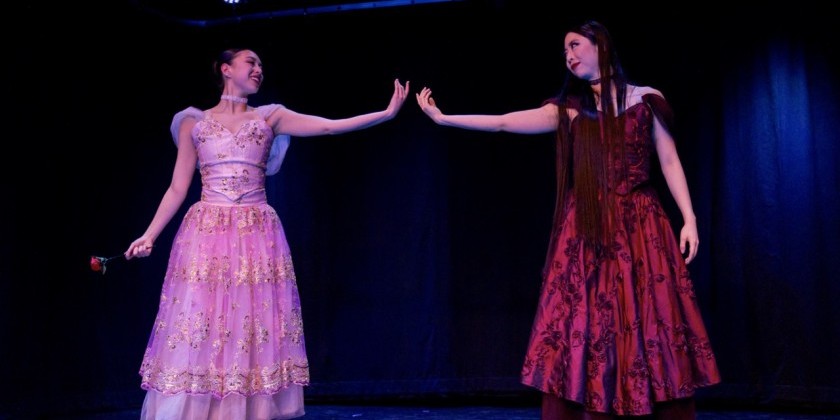
Both Gothic literature and 19th-century Romantic-era Ballets are characterized by their psychological nature, emotional depth, female-focused narratives, and supernatural elements. For Romantic ballet, tradition is also marked by its use of mime, controlled pointework, and a light, graceful movement quality. Carmilla incorporates this romanticized quality as a symbol of innocence, femininity, and societal structure, most strikingly embodied in Laura’s character. Laura encompasses the hyper-feminine ballet stereotype, from her pink, white-laced bedspread, tightly wound hair, and silk nightgown, to her glittering pink princess-style gown and matching choker. She gracefully waltzes around the stage en pointe with controlled arabesques and suspended port de bras. To contrast this fluidity, Carmilla introduces Gothic elements through sharply textured contemporary movement and a darker stylized appearance.
Adorned in pointe shoes, a glittering red gown, and matching choker, Carmilla seems to mirror Laura, but doesn’t quite fit the Romantic ballet form. Her long dark hair is only partially contained, half pinned up with a red rose, and the other half flowing freely down her back. Although she echoes Laura’s movement, she can’t fully emulate the same smooth quality and emotional resonance, conveying instead a twisted reconstruction. While the sequence is there, the movement is robotic, passive, and hollow; lacking the humaness attributed by seamless transitions, clear intentions, engaging eye contact, and suspended extensions. Glimpses of Carmilla’s true nature slip through her mask in contemporary modern motifs, interrupting the choreography with jerky, stiff, bat-like gestures and unpredictable jump scares. These mannerisms only add to Laura’s family’s growing suspicions that Carmilla is a human imposter. Beneath the facade, she’s a monster. These partial freedoms in Carmilla’s appearance and movement foreshadow the graceful decay of Laura’s character and the Romantic ballet structure to come.
As the ballet progresses, controlled elements from Romantic ballet disintegrate, giving way for abstract contemporary modern forms to influence the characters’ movement, emotional expression, and storytelling process. While stylized Romantic-era Ballet mime is crucial in the beginning to the characters’ communication with each other and the audience, this calculated approach fades with rising tensions. When word comes of Laura abandoning her family for Carmilla, her mother no longer shakes her fists sternly to signal conflict. Her body becomes it. Her fists bring her down to her knees, her grief-stricken body contorting as emotional distress takes its raw and truest form. The other characters mirror this decay with growing theatricality, uncensored facial expressions, vocalization, earnest contractions, impulsivity, and exaggerated reactions. But no one gives in to their impulses more than Laura.
At the climax, Laura swaps Carmilla’s rose for a wooden stake and returns to the woods to confront her. During an intimate pas de deux, the stake switches between Carmilla and Laura’s hands, reflecting shifting power dynamics and Laura’s indecision. This is our final glimpse of the dwindling Romantic ballet influence before Laura’s choice brings about its final decay. When Laura sheds her pointe shoes, it becomes an act of defiance. She rejects the binding societal standards around identity and sexuality represented by the shoes. Barefoot, she lets her hair down, allowing this action’s structure-breaking freedom to extend to her movement quality, shattering Romantic ballet’s smooth, upright, and predictable nature with freeform, contemporary movement. Arching, curling, swooping, and flinging, the two wear each texture as if luxuriating in new skins. The more Laura relishes in it, Carmilla’s true fear is unveiled: Now she is love’s victim. In response to this terrifying realization, she self-sabotages, giving Laura her lethal bite. But Laura has already chosen. She drinks Carmilla’s blood, relinquishing her old life and planting new seeds in its decay.
Laura and Carmilla spin erratically, as if they’ve lost all control, but gained freedom in each other’s imperfections. This final image leaves the audience longing for the same release– hesitant, yet unable to turn away from the inner battles holding them back– leading viewers to question: Is what or who we’re demonizing truly what we fear?
Carmilla suggests there's beauty in facing our devils. The key to freedom is found in the decay.
Author:
Lilliana Miller
Website:
https://lillianamiller.weebly.com/
Photo Credit:
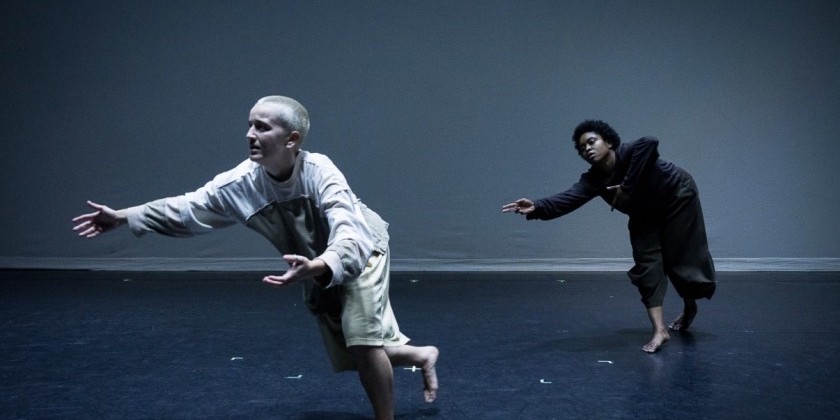
Claire Pennington (Right) and Reese Desaulniers (Left). Photography by Taylor Craft.